Showing posts with label Panamanian Culture. Show all posts

Wednesday, September 28, 2016

Bring Your Parents to Peace Corps and other April Events

Easter
I spent Easter in site.  My town has a really cool dramatization of the Passion of the Christ.  They set up a big stage in front of the Church and most of the community turned out to see the performance.  It's typically about 2-3 hours of a stage performance and then they walk around the community to do the Stations of the Cross.  The entire event can last until midnight or 1am.

My friend Roxana came to visit and we went to the show, but we only lasted a few hours, between the event starting "late" (by my estimation, but 2 hours after the announced start time is totally normal here) and my habit of waking up at dawn, my night owl stamina is pretty much gone.


Adventure to the Azuero!
After Easter I went on a short trip to see my friend Tara in Mariato before she finished her service.  It was really fun to see another part of Veraguas.  We made delicious food, played with her cats (who are Canela's mom and sister), and read books in hammocks.

We also went to a cool event called a "Lasso Libre".  There's vaquero (cowboy) culture where Tara lives because people raise cattle there.  Lasso Libre is an event where people try to rope calves from horseback as they run to their mothers out in a field.  The goal is to rope the calf the fastest.  We hung out there for awhile and bought food.

We also paseared to her neighbors and host family.  We ate some delicious sancocho (traditional chicken soup and ñame) and drank some amazing chicha de limon con raspado (lemon juice with sugar cane sugar), and ate espuma (the bubbles that come up when you process sugar cane into sugar), which is like molasses, but lighter.  It's sort of like eating a cross between cotton candy and caramel.

It was a lovely weekend full of food and friends and food and travel.
Road in Tara's town


Site life: Community Class an English Clubs
In site I was teaching a Community English Class and trying to get momentum on two fusion English/Leadership clubs for students.  English class started well I had 16 adult students and I used a curriculum that was developed by a previous group of volunteers.  It was harder to get momentum with the English clubs because the school schedule shifts and my schedule was a little variable with having to be out of site for trainings, so students would forget or I would be gone.  Even with all the logistical struggles, I really love teaching and everyone who came to the clubs and classes had a good time.

Bring Your Parents to Peace Corps
So, I was both really excited and a little nervous to have my parents come visit me in Panamania.  I love my life here, but I knew it would be a little...grittier than previous international travel experiences that they've had and I didn't know how they'd react.

On the appointed day I went to Panama City to pick them up at the airport.  We have fancy IDs that allow us to meet people at the gate, but the process is a little confusing.  Luckily my friend Jody was meeting her parents around the same time (Unofficial Peace Corps Panama Parents Week 2016), so we were able to navigate the process together.  Jody and I split up after we got through security because our parents were arriving at different gates.

When they finally arrived we zipped through immigration and security to get to the hotel.  At the hotel we relaxed for a bit (I took a wonderful, rare hot shower) before going out to dinner at Tantalo in Casco Viejo and then wandering around and getting ice cream before crashing hard.

The next day we woke up early and went to the Canal.  There's a really cool museum at the Miraflores locks.
The Panama Canal

Parents!


After we went to the Canal we grabbed lunch like tourists at the TGI Friday's in Albrook (I was easing them into Panama).  After lunch we went to the Biodiversity Museum, which is a really cool relatively new museum out on the Causeway.

One of the sculptures in the museum
I'm not really a person who takes photos in museums, so that's the only one I have (other than the one that I took of the ellipsoidal lights that were lighting one of the exhibits...I miss theater life).

After the museum we ate dinner and went to sleep early because the next morning we were going to Veraguas :)

We got up early and got on a bus to Santiago.  Four hours later we arrived and I took them to Kandela's (the best fonda, traditional Panamanian restaurant in Santiago) for lunch, did some quick grocery shopping, and then got on another bus to head to my house.

I introduced them to Canela and we went next door and met my neighbors and then made dinner at home.

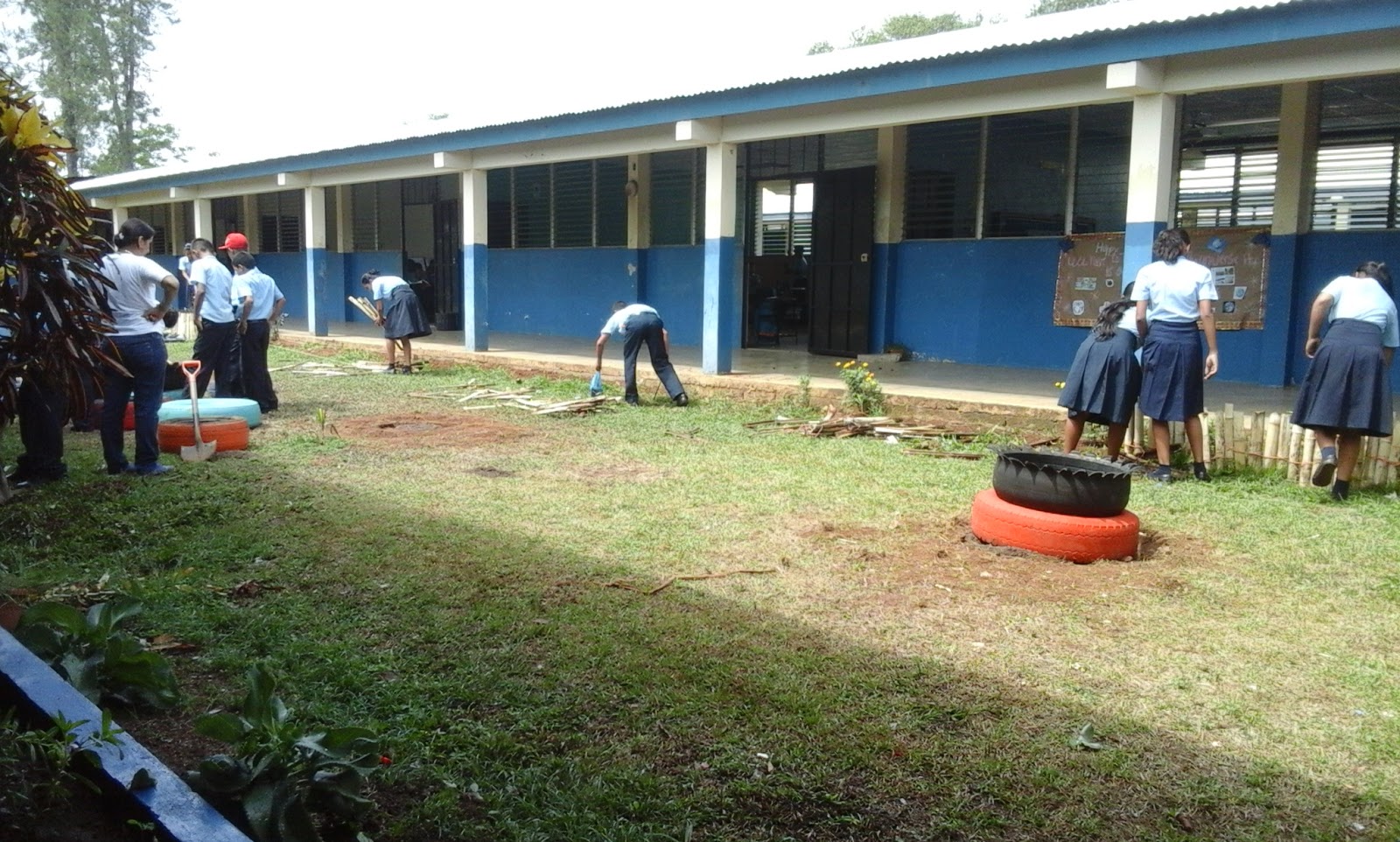
The next morning we had a quiet breakfast and then went to school so they could meet the English teachers and the rest of the staff and kids.

The students were gardening that day, making flowerpots out of tires

After school we went into Santiago to have lunch with Kelly and Roxana and go grocery shopping because we invited my neighbors to dinner that evening.

My neighbors loved dinner and the next morning they invited us to breakfast before we left for Santa Catalina.

Parents and Neighbors
We ate breakfast and then got on the road for the long trip down to the ocean.

We hiked on the beach and went snorkeling at Coiba.  It was beautiful and really fun.

Sunset at Santa Catalina
Hanging out on the boat

After Santa Catalina we made the long trip back to Panama City.  The next day I took them to the artisan market at 5 de Mayo and then to the airport.  I was sad to see them go, but I think they had a really good time and I loved sharing Panama with them.


Tuesday, March 22, 2016

So, They Say It's Your Birthday...

This is my second of three Peace Corps birthdays. 

Birthdays, Panama Style
Before my birthday my only Panamanian birthday experience here so far has been Prima’s birthday last week.  We sang Happy Birthday, had sheetcake that her daughter bought from a supermarket in Santiago, red jello with ice cream on top (a party favorite here), and I got to take a swing at the piñata (full of hard candies and noisemakers) with the rest of the kids.  It was a lot of fun.

·      Part 1
This year my new friend Gabby from G78 was visiting me for the week.  We spent Friday morning at school observing and hanging out with Cora (my CP who teaches English for grades 7-9).  We even did some family member vocabulary review with the students in preparation for a project that they’re going to do next week.

In the afternoon we went to El Palo de Granadillo, which is a tree in a nearby community that only blooms around Easter.  A lot of people from all over Panama come to see the tree bloom because it’s considered a holy place and the flowers have medicinal uses for pain relief. 

After we got back from the tree Gabby and I hung out for a bit and started making dinner before heading back to Prima’s house for an holajdre making lesson.  Hojaldres are pieces of fried dough that are a common breakfast food in Panama.  After our  cooking lesson we finished making dinner (quesadillas and mashed potatoes) and watched Big Hero 6 (which was not what I was expecting at all).
El Palo de Granadillo

One of the famous flowers

I finally visited the Rio (river) that my town is named after

And found the mysterious hidden IPT (technical high school) near my town


·      Part 2

The next morning on my actual birthday we spent the first half of the day at a youth leadership project development workshop at the FUSODEP office in Santiago because they’re interested in collaborating with Peace Corps to create some sustainable (led by Panamanian youth) opportunities for youth in Santiago to participate in extracurricular activities that would fill needs that the youth leaders identify in Santiago.  It’s a pretty fantastic idea and we’re really excited about it, though we’re still developing what we’re actually going to do in the community. 

The workshop was great and it was awesome to show the visiting  G78ers a larger scale project that we’re working on in Veraguas (especially because it has such high potential for being sustainable and making a huge positive impact).

After the workshop we bopped around Santiago for a bit, went to the mercado (market area with a lot of shopping), got raspao (shaved ice with fruit flavoring and condensed milk), and finally explored the new mall that they’re building on the outskirts of the city.  It’s crazy big and they’re putting in a movie theater (Santiago’s second one), but the really awesome part is that there’s a bus that goes there for free from the mercado (saving 40 cents in bus fare).  

After the mall adventure we got dinner at this really cool restaurant and hung out after to bake carrot cake and watch most of NO, which is a really cool movie about the “No campaign” that helped end the dictatorship in Chile.  Gael Garcia Bernal is a fantastic actor and I'm sort of obsessed with democratic political transitions.

Birthday Dinner with Team Veraguas and the G78ers who were visiting for the week!

Dinamicas (Ice Breakers) during the Youth Leadership workshop!

·      Part 3
The next day I did laundry, chatted with my parents for a bit, and celebrated with my neighbors.  We had cake and sang “Happy Birthday”.  I almost have all the words to the Panamanian version; it’s different than the one I learned in Chile.  After celebrating I fell asleep in my hammock with a good book (Little Bee, go read it) while waiting for my laundry to dry before eating some delicious leftover pasta for dinner.

Birthday cake with best friends

Singing Happy Birthday

Delicious Cake that Prima got for my Birthday

Singing Happy Birthday to Manuel too!

Really solid birthday.

And now for a little retrospective:

·      Ten years Ago
I was 17 and in the 11th grade.  I spent all my time studying Chemistry and American History,  and writing and reading for English class (and for fun).  I was in Marching Band, chorus, the school musical (Bye Bye Birdie), and jazz choir.   

When I wasn’t studying or at school I was dancing (Ballet, Jazz and Irish), sitting in Greg’s living room watching B-movies, or not-quite-loitering in front of East Sevs (one of two 7-11s in my town).  I worked for my dad on weekends.  I had my driver’s permit, but not my license and I hadn’t started seriously thinking about leaving Long Island.

I had just met the girl who would become my best friend/sister and future co-star of the “Kara and Jess show” where we do things like make incredible messes while making box brownies, get lost in East Patchogue, and go “piano-man-ing” (driving aimlessly) with the windows rolled down and the music blasting.

·      Five Years Ago
I was 22 and a senior in university.  I was working toward finishing a dual degree in Spanish/Latin American Studies and International Studies/Peace and Conflict Resolution.  I was studying Arabic for fun and I had just gotten back from a semester abroad in Santiago, Chile. 

I had moved to a new apartment with old roommates where I built a free-standing wall to partition part of the living room into my bedroom.  I went back to my job working at the university mainstage as a technician (carpentry and electrics) and Box Office Assistant/House manager.  We were about to go into rehearsals for Rosencrantz and Guildenstern are Dead , my last of 11 shows with the Rude Mechanicals student Shakespeare troupe.   I was back to dancing (Modern and Jazz/Contemporary) after stopping for a few years and I was almost over a severe knee sprain and I hadn’t injured my shoulder yet.

I had just gotten back from my Grandma’s funeral and been rejected by Teach For America.  I had no idea what I wanted to do after graduation, but I knew I wanted to stay in DC, so I was about to attend my first tech cattle call to solicit theater work and start my freelance life.

I can’t believe how much has changed and how remote, yet recent it still all feels.


Year Bucket List
  • Learn ASL
  • Facilitate a seminar solo
  • Work out at least twice a week
  • Write in my journal for 10 minutes every day
  • Read for half an hour every day
  • Sew a dress for Fiestas Patrias in November
  • Hike Volcan Baru
  • Bake cookies with Prima’s daughters
  • Practice Spanish for at least 1 hour every day
  • Take the Foreign Service Officer Exam
  • Retake the GRE
  • Do cool stuff in site (in all the many forms that can take) 
  • Visit the provinces in Panama I haven't been to yet 


Thursday, March 10, 2016

The End of "Summer" (or the Month of February)

Ok, so it's not really the end of Summer (that's around May), but it is the end of February and school is about to start again.

Carnaval (Part 1)
I spent the beginning of the month (and the first part of Carnaval) madly studying to take the GRE in Panama City for my future return to study something for my MA.  I really don't know what I want to study or where I want to go to school or if I want to go back to school immediately following Peace Corps.  This may have been just another part of this quarter life crisis exercise.   The test was harder than I thought it would be (partially because I haven't taken a standardized test like that in almost a decade), but I'm hoping I did well so I can really focus on working in site this year and worry a little less about the future.

Carnaval (Part 2)
To celebrate surviving the test, I got some tacos from my favorite "hole-in the-wall" place around the corner from my home sweet hostel in Panama City.  The next morning I tried to get out of the city early (despite everyone's apocalyptic traffic predictions) to go to my friend's place for Carnaval.

In the end it only took me about 4 hours to make what should have been a roughly 3 hour trip (less apocalyptic than initially predicted).  My friends Erin, Adrian, and I decided to go out to the culecos almost immediately after I arrived at her place.  I don't know if the word is used outside of Panama, but culecos are water trucks that spray the dancing and drinking crowd with water during Carnaval (and because of all the water I have no photos).

There are also competitions for Reina (Queen) for Calle Arriba versus Calle Abajo in most places.  The division is based on which part of the community you live in. The women are dressed up in extravagant costumes and dance tipico on floats pulled by tractors.  The tractors drive right through the crowds by the culecos, which is terrifying to think about, but everyone knows to just get out of the way when the tractor comes inching through the crowd pulling a giant float on a flatbed.  Kids have water guns filled with ice water and will spray unsuspecting passersby.

Because we're in the middle of dry season (and rainy season wasn't that rainy this year) they had to dredge some of the rivers in Panama to get the water for the culecos.  We're not in a drought, but I do have friends whose water only comes for a short period of time every few days and the water that was used for the culecos could certainly have had some more practical uses (washing dishes, bathing, drinking water) than being sprayed on a crowd (though that was quite refreshing).

The next day I headed home to site (where we also had culecos, but I didn't participate) to get myself organized to start prep week for the new school year on Monday.

Campamento Muchachas Empoderadas
Right before prep week started a bunch of us spent a week in my friend Jody's site in Chiriqui near the Comarca Ngäbe Buglé (CNB) helping her with her Muchachas Empoderadas (Empowered Young Women) Camp.  The CNB is one of two indigenous areas in Panama and has two distinct indigenous groups (the Ngäbe and the Buglé).  The other Comarca is in the Darien (bordering Colombia) where the indigenous groups are the Embera and the Wounaan.

All week we spent the mornings doing leadership and teambuilding games, talking about role models, goal setting, self esteem, and making recycled jewelry and friendship bracelets, and learning the really awesome dance that Jody choreographed.
Fany sharing a valentine to herself


Laila sharing about inner and outer beauty 
(with a little help from her friends)

The last day of the camp the girls presented their work to their family, our CD, her husband, and APCD who came to visit for the final presentation.  Each girl shared something that she had learned that week in our sessions about goal making, role models (the majority of who cited their moms as their role models), and self esteem exercises (inner/outer beauty and valentines to themselves).  It was a really lovely camp.

Dancing!

Muchachas and facilitators

I spent the week at Jody's lovely little house with fellow PCVs Roxana, Kelly, Natalie, and Meredith.  It was also the first time in my life I lived somewhere that didn't have a refrigerator or regular running water.  Because it's dry season Jody's water has only been coming for about an hour every few days, but she also has access to a local spring.

Jody has electricity, but she doesn't have a fridge.  Despite how scary that might sound, you don't actually need a fridge to feed yourself delicious food.  You go shopping every day for food that might spoil quickly, eat vegetarian, and don't make more food than you're going to consume in a single meal/day.

We made oatmeal with honey, peanut butter, and raisins every morning for breakfast, sandwiches for lunch (PBJ or tuna), and a variety of things for dinner.  Because there were so many of us we each took turns cooking dinner for the group.  Dinners included: pasta with ginger, garlic, and soy sauce; roast vegetables and chicken; black beans and vegetables (with a mashed potato appetizer); black bean burgers with vegetables and fried plantains; wachu (which I can't spell; stewed beans and rice).  We even made no-bake cookies for the last day because Jody correctly anticipated the potential of entertaining our CD, her husband, and APCD at her house.  All of this was accomplished without a refrigerator (or an oven).

In general, Jody's site more closely fits what I imagined Peace Corps would be like.  She lives in a small town with dirt roads and lives in a concrete house (with Tara the tarantula who lives near the shower).  She has a latrine for a bathroom and her "shower" is a tarp cubicle next to her house with a dirt floor and a bucket.  She saves water in buckets for when it goes out and purifies water with a water filter and drops of chlorine.

Despite voluntarily joining the Peace Corps with this being my imagining of volunteer life, a year ago I couldn't imagine living like that.  But before I went to Jody's site I wasn't stressed about the water situation (the surprise tarantula housemate was even ok once we understood what eachother's boundaries were).  I missed pulling cold water out of my refrigerator and having toast with butter and jelly every morning for that week, but not so much that it was a real hardship.  Don't get me wrong, not having water (or safe water) is super frustrating, but I now know that I would be capable of doing the things necessary to live like that, which I didn't know before.

Some Empowered Muchachas with our APCD, CD, and (some of) the facilitators 
(missing Roxana and Kelly)


Prep Week
Prep week involved some discussion of diversifying teaching methods to help students succeed, which was really cool to see.  They also discussed education laws, selected school event committees (every teacher is assigned to one of about 7 committees to organize events throughout the year), organized and cleaned the classrooms (they painted over the summer!) and generally got things ready for the new school year.  None of the English Teachers were around during prep week because two of them were still studying in the US with the Panama Bilingue program and one had not yet been assigned to the school.

Birthday Celebrations!
The Friday of Prep Week was my friend Kelly's birthday, so a bunch of us headed out to dinner at this awesome Greek place in Santiago (that I didn't know existed) and then back to Kelly's for a slumber party full of popcorn, singing Taylor Swift, playing "Never Have I Ever", and the traditional PCV external hard drive media swap.  The next day Kelly made pancakes and scrambled eggs and then we all went to lunch at a fonda in Santiago before going our separate ways.

That weekend a previous English Teacher Counterpart (Maria) who left to study with Panama Bilingue in August texted me to say that she's coming back to my school this year.  I'm so excited to start working with her again!
Birthday Fun!

More Training (but from the opposite side of the table)
In theater we talk about being "in front of the table" or "behind the table", meaning are you the person running the audition or are you the person auditioning?

G78 (the next group of Teaching and Conservation volunteers) arrived at the end of February and right after Kelly's Birthday I headed back to the training community in Panama Oeste to support our PST (Programming and Training Specialist) for the first week of G78's training as incoming TELLS volunteers (Teaching English, Leadership, and Life Skills).  It was very strange to be "on the opposite side of the table".

I feel like I'm supposed to be "old and wise" or "a veteran PCV", but what 78 doesn't know is that I'm still figuring it out too.  It's really interesting to consider what I know now and compare it to my perceptions of G74 (the previous group) when they came to train us (G76).  I know more than I did when I got here, but there's still so much that I'm figuring out.

The week of training went really well.  G78 is an awesome group and I'm really excited to start working with them after they finish training.

At the end of the week we all hiked the Loma together for a bit of exercise and to celebrate the end of the first week.  It's so beautiful and peaceful up there.

The really tough part of working on that first week of training for G78 was that it meant missing the first week of school in site (and missing the first VAC meeting of the year).


On top of the Loma, one year later

(My) First Week of School
Two of my three counterparts are back in school this week and we're going to have a department meeting to discuss goals and projects for the year.  I'm also preparing to start an English Community Class and an English Club (or two, depending on interest) for students.  I tried to start my community class at school this week, but no one showed up, so I'm in the process of re-advertising and shifting location to hopefully garner more interest.

There are so many projects on the horizon that I'm a little overwhelmed with how (and when) to get everything started, but I'm confident that this will be a fantastic year.  I got to formally introduce myself to alot of the parents when they came to the school for beginning of the year parent/teacher meetings, which I think will be really helpful in starting to build some of those relationships.
Class Time!

Upcoming

  • English Community Class
  • English Club(s)
  • Gabby from G78 comes to visit!
  • Celebrating my birthday!
  • Planning for a trimester break camp in June
  • Starting the planning process for the Regional Reader's Theater Competition
  • And many more adventures


Saturday, February 13, 2016

A Tour

The word that I always hear my gente (community members) use to describe my town is tranquilo (calm).  

Top Five Ways to Spend Time in my Site:

1. Visit the Church and adjacent park: 

There's a big Catholic church in the center of town (in addition to the Mormon and Jehovah's Witness houses of worship).  It's simple and elegant.  I can hear the church bells from my house, which is not terribly pleasant when they wake me up at 6am on Sunday, but also makes me nostalgic for the song of church bells floating through the air in my hometown.  The park is beautifully green with lots of trees (perfect for playing hide and seek) and has a lovely gazebo in the center of it (perfect for escaping sudden rainstorms and holding impromptu English lessons).  
Park!


2. Play with (or teach) the neighborhood kids: 

The majority of the kids in my site go to school in town and we're slowly becoming friends.  Sometimes they show up at my house and we play games like chess, hide and seek, or frisbee.  Chess and frisbee are new activities for them, but rapidly becoming highly requested.  Sometimes I "play cards" with my neighbors, but she and her brother are 5 and 4 years old, so our card games are usually based on shifting rules that she makes up and changes at will.  I never know what's going on, but it's always a good time.  New goals include teaching her and her brother "Go Fish" to give our card games some more structure.  Story time is also a hit.

3. Pasear to Prima's: 

Going next door to hang out with Prima's family is one of my favorite things to do.  Prima is willing to answer all of my questions about cooking and my site and I answer her questions about my life in the US and Peace Corps.  Her two youngest daughters are still in school (university and high school) and they're really fun to hang out with.  The visit will be full of laughter and probably food.

4. Cook Patacones (or "Peace Corps French Fries"):  

Fry: Start with some Platanos Verdes.  Draw a large kitchen knife down one of the ridges on the platano to break through cascara (shell/peel).  Peel the platanos and then cut them into roughly half inch wide sections with 2 flat sides.  Put all of those pieces onto a plate.  Take a frying pan and pour about a half inch of vegetable oil (or whatever kind of cooking oil is in the local tienda).  Set a empty second plate next to the frying pan.  Turn the stove on and put as many platano pieces as will comfortably fit (usually no more than 8 at a time, depending on the size of the pan).  Fry them on both sides until they're golden brown.  When they're done take them out of the pan and put them on the second plate.  Repeat until all the pieces are fried

Smush: Take your handy dandy patacon maker (or the flat side of your kitchen knife) and aplastar (smush flat) all of your fried pieces are flattened.


Patacon maker

Fry: After all the pieces are aplastado (flattened), fry them again for a few minutes.

To be enjoyed with ketchup or salt (or both).

5. Eat some mimbre in a hammock:  

Mimbre (or fruta china) is delicious.  We tend to call it "star fruit", which always makes me think of "star leaves" from The Land Before TIme.  

You could also eat some mamon, mamon chino, or an orange Panamanian style (cut a top section off and suck all the juice out).  

Hammocks are a perfect way to pass a windy (hot) summer afternoon (reading, writing, studying, sewing, or napping with a purring kitten).


Blogging Abroad's Boot Camp Blog Challenge: Starting January 2015

Monday, February 1, 2016

Que Dijeron?

I haven't heard many dichos (sayings) in Panama, but another volunteer told me an interesting one.

Here's the story (as I remember it):

There was a family of mice who were being terrorized by a cat.  Every time they left their home to get food the cat would appear and chase the mice away.

The mice were trying to come up with a solution to their cat problem.  After a couple of ideas were dismissed outright, one of the mice suggested tying a bell (cascabel) to the cat's collar so that they'd be able to hear it coming.  All of the mice thought this was a fantastic idea.

One of them asked "pero quien va a poner el cascabel?" (But who is going to put the bell on the cat?) and none of them volunteered to do so.  The cat problem went unsolved.

Meaning/Analysis:
Great ideas are meaningless if no one will take the risk to put them into action.

To be used in situations where lots of good ideas are floating around, but no one is putting them into action.


Other things that people say:
1. Something that Panamanians say in conversation all the time is oiste? or oyo? (did you hear?), especially when explaining something or giving directions.  It seems odd because typically there's no way that you could have not heard the person, you may not have understood them, but you definitely heard them.  It's just something that people say here and most of the time it's a rhetorical question.

2. Me explico?
I really like this construction.  It means "Am I explaining myself?" and it's much nicer than saying me entiendes (Do you understand me?) because it places the burden of being understood on the speaker instead of the listener and doesn't make the listener feel unintelligent or silly if they need to ask for clarification.

3. Buenas
The most common greeting in Panama.  It literally means "good", but is used to greet people on the street as you're pasearing in your community or to call into a neighbor's house (or store) to see if anyone is around and to get their attention.

4. Vaina
Literally means "thing/stuff" but can be used in conversation to refer to almost anything in a positive or negative way.

5. Chechere
Similar to vaina, it also means "things" or "stuff" but in a less formal way, closer to "junk"

6. yeye
Meaning "fancy", "rich" (monetarily), or "posh".

7. Bochinche
Gossip.  A person can be bochinchos@.


Blogging Abroad's Boot Camp Blog Challenge: Starting January 2015

Sunday, January 31, 2016

Good Rivers Make Good Neighbors

One day during my first three months in site when I was still living with my host family, I was walking home from the store in the late afternoon and I decided to take a long way back to the house (mostly to avoid the hissing and catcalls from the local bar).  Prima, her husband (Mariano), and her sister in law (Loli) were sitting on Loli's porch.  Prima teaches 2nd grade at school, so I'd seen her when I was observing English classes with my counterpart, Maria.  Not many people hang out on their porches in my site, but they seemed to be having a nice conversation with eachother, so I decided to try my hand at pasear-ing and say hello to them.  

They invited me to sit on Loli's porch and Prima gave me fruitcake and chicha (juice).  I sat and chatted with them for half an hour or so before I saw the time and wanted to be home by dark.  

I visited with Prima a few more times after that and we became sewing friends during the traditional sewing workshop at school.  When I was looking for a house she told me that her other sister in law was looking for a calm and responsible person to rent the house next door and I jumped at the opportunity.

Since I moved into my house in mid-August Prima and her family have pretty much adopted me as their 6th daughter (right in the middle between the oldest three and youngest two).  For Christmas this year she let me use her oven to bake cookies, which I then gave out to my host family, counterpart's family, and of course Prima's family as Christmas presents.  It was a solid cultural exchange win.

During the rainy season the strip of grass between the houses floods into a muddy mess, so I started calling it a "river" and Prima's husband started joking that he's going to build a "bridge" over the river.

Prima's spent her entire life living in my town (aside from when she was at University) and she's probably my closest adult friend (her 5 year old granddaughter is my closest kid friend).  

When we're not at school she spends most of her time cooking, cleaning, and visiting with family who live in the area (or entertaining family and friends who come to visit).  She's really good at traditional embroidery and I'm hoping she can help me design a dress for Fiestas Patrias (National Holidays) next November.  

Prima is amazing and always greets me with a smile (when she's not jokingly heckling me for walking around without shoes on).


Prima with her grandkids during Fiestas Patrias last year


Blogging Abroad's Boot Camp Blog Challenge: Starting January 2015


A (Wo)Man, A Plan, A Canal, Panama

I did some research about Panama before I came here, but I knew there would be a huge learning curve (though I had no idea quite how big that curve would be).

So, here are a few things I didn't know before I came here:
  • How to take a bucket shower
One of the things I had to learn how to do during my first week in Panama was how to take a bucket shower.  They take some practice (and some courage to get that first bucket of cold water over your head), but are really environmentally friendly (you use much less water) and quick once you get the hang of it.  It can be hard to get conditioner out of your hair though.

  • The US invaded Panama in December 1989 (Operation Just Cause)
As an International Affairs and Latin American Studies major in college, I'd read a lot about various interventionist activities that the US has been involved in, but I didn't know about the 1989 US invasion of Panama.  

The invasion came as a result of a dispute over election results and a perceived threat to US interests and personnel in the Canal Zone.  During the invasion Manuel Noriega, who had governed Panama as an authoritarian dictator since he came to power in 1983, was removed from power.  The casualty numbers and description of the extent of structural damage change depending on who you're getting your information from, but it had a lasting impact on Panama and on US foreign policy in the region.

The Peace Corps/Panama program was established in 1963, but Peace Corps actually left Panama between 1971 and 1990.
  • The rest of the country is very different from Panama City
Being in Panama City (or Panama as it's referred to locally) is like being in the US.  It's what I imagine Miami might be like.  There are skyscrapers, high rise apartment buildings, fancy hotels, and giant video screens with advertisements like you'd find in Times Square.  The vast majority of the wealth that the Canal generates stays in Panama City, where about half the 3.5 million population of Panama lives.  

Outside of Panama City it's much different.  Most buildings are one story (or maybe two), sometimes the lights or the water go out (if you have running water and electricity, which most people do, except in the most rural areas), there are stray dogs in the street, and a general lower level of income.  

I'm struggling to describe it because when you see something so close and live in it you lose some perspective.  Everything here is true (to my current knowledge), if a bit scattered.  I'm going to get some perspective from friends and flesh this out more later.
  • There's a break in the Pan American Highway called the "Darien Gap"
The road ends in a town called Yavisa in the easternmost province of Darien.  They haven't been able to continue the road through this area due to very dense rainforest, environmental concerns related to rainforest preservation, and opposition from local indigenous groups, so the road picks up again about 100 miles later in northern Colombia and continuing on to the southern tip of Chile where it ends.

My friends who live in Darien tell me that some tourists don't know that the road ends and refuse to believe border police officers when they try to explain that you can't drive all the way through (I think you can take a boat to Colombia from Panama City), so they end up driving all the way to Yavisa before having to 
  • The difference between corn and flour tortillas (or how to make them)
I didn't know there was a difference between corn and flour tortillas beyond one being yellow and the other being white.  In Panama corn tortillas are a common breakfast food.  They're little hockey puck-ish disks of corn flour dough that are fried.  They can be either white or yellow, depending on the kind of corn flour you use.  Volunteers tend to like to eat them with hot sauce.  My host sister in site runs the kiosko at school, so I'd help her make tortillas at night to sell at school in the morning.  They also sell frozen ones in the supermarkets that are thicker than the homemade ones and come in bags like the frozen bagels that you can buy in the US supermarkets.
  • You can get almost anywhere on a bus in Panama.
Buses are really easy and cheap to navigate in Panama.  You can really get almost anywhere on a bus, and the places you can't get to you have to take a boat or hike.  I didn't anticipate travel to be so easy.  It's also possible that I'd changed.  During training we had to move around alot, so I got really proficient at packing my backpack and better at traveling in general.  
  • You should always ask more than one person for directions when you're walking somewhere
In the land of nameless streets (ok, some streets have names, but really only in the cities, and even then they're not marked most of the time) sometimes people will pretend to know what you're talking about and give you bad directions because they don't want to lose face by telling you they don't know.  So, just keep asking people on the street as you follow the first set of directions.  This also helps to counter the effects of pa' alla (over there) accompanied by a hand gesture, which is a common way of giving directions.  Time estimates will also always be lower than the reality and asking for anything like a number of city blocks will just make people look at you funny.  You'll get lost and frustrated and overheated, but you'll probably make it there eventually if you're persistent.
  • Mirrors can be totally optional
Despite being very appearance focused here (it's a sign of respect and professionalism to look good), I haven't seen a ton of mirrors in people's homes.  During training my host family only had one mirror and it was in a dark-ish alcove next to their bedroom.  My first host family in site didn't have any mirrors in the house (that I saw), but my second host family in site had a mirror in the bathroom.  In my house right now I have one mirror in my bathroom that's too high for me and a compact that I use sometimes.  Most days I don't see my face.  I've never spent much time in front of the mirror, but not having one Initially it bothered me.  But now, I've gotten used to it and being in a well-lit bathroom with a mirror can be a treat.
  • How important "always looking on the bright side of life" would become
Peace Corps is hard.  Everyone has their own battles specific to them and their service and not comparing yourself to others can be really hard to do (site/project jealousy is a real thing).  It's really important to celebrate the small victories (like catching the bus when you were cutting it close or having a student say hi to you in the street) because it makes getting through the bad days easier (when the water is out, and there's a giant spider, and your cat poops in the shower).  

Trying to practice active empathy and being able to laugh at how ridiculous life can help more than you may initially realize (and friends, friends are really important, especially when that bright side is hard to find).


Blogging Abroad's Boot Camp Blog Challenge: Starting January 2015